Scientists Now Agree: Protein Is the Most Powerful Tool You Have for Fat Loss and Muscle. Most Adults Are Getting Less Than Half of What They Need.
Muscle loss begins at 30. Fat becomes harder to shift. Metabolism slows. The research explains exactly why, and what the best practitioners are recommending to reverse it.

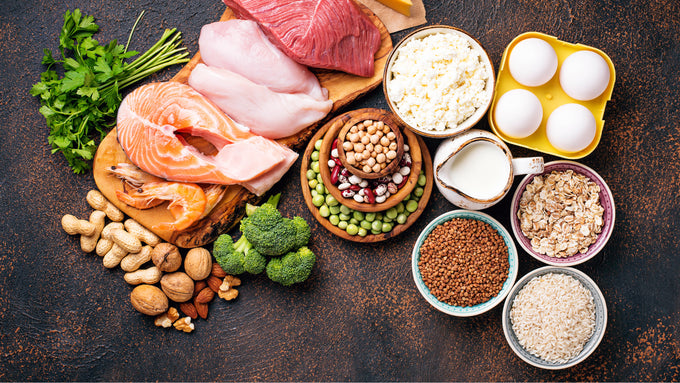
Most adults consume less than half the protein required to preserve lean mass and support fat loss as they age.
Most people already know protein is important. What they do not know is exactly how important it becomes the moment you turn 30. And what happens, month by month and decade by decade, when your intake falls short.
A substantial and growing body of peer-reviewed research has shifted how sports scientists, dietitians, and longevity researchers think about dietary protein. It is no longer seen simply as a tool for bodybuilders or athletes. Protein is now understood as the foundational nutrient for anyone who wants to maintain body composition, manage weight, and preserve metabolic function as they age.
The problem is that most adults are nowhere close to consuming enough. And the consequences are not abstract. They show up in the mirror, in the gym, and eventually in the doctor's office.
"Protein is not a fitness supplement. It is the most metabolically active macronutrient we consume, and most adults are chronically deficient in it by every meaningful clinical measure."
International Society of Sports Nutrition, Position Stand 2023What Happens to Your Body After 30 (and Why Most People Miss It Until It Is Too Late)
Muscle loss from aging has a clinical name: sarcopenia. It begins earlier than most people expect, and it progresses quietly for decades before becoming obvious. Research published in the American Journal of Clinical Nutrition documents an average loss of 3 to 8 percent of muscle mass per decade starting in your thirties. After 60, that rate accelerates.
This matters beyond aesthetics. Lean muscle mass drives your resting metabolic rate. Less muscle means fewer calories burned at rest. Fewer calories burned at rest means the same eating habits that kept you lean at 25 produce gradual, consistent weight gain at 35, 45, and beyond. Most people experience this as a mystery. It is not. It is arithmetic.
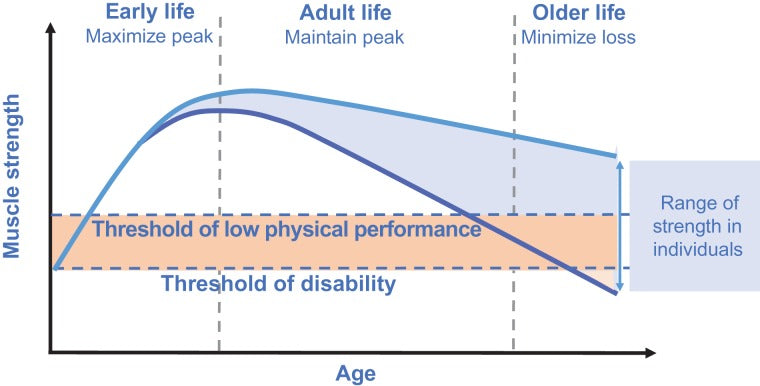
Sarcopenia, the age-related loss of lean muscle mass, begins earlier than most people expect and accelerates steadily without adequate protein intake.
The practical implication is straightforward. The window to build the lean mass that protects your metabolism and keeps your body composition favorable is open now. Every year of inadequate protein is compounding loss that becomes progressively harder to reverse. This is not alarmism. It is what the longitudinal data shows.
Sarcopenia and Protein: What the Longitudinal Data Shows
A multi-decade cohort study tracking adults from age 30 through 70 found that individuals with consistently higher dietary protein intake preserved significantly more lean muscle mass across every decade compared to low-protein counterparts.
The clinical recommendation: 1.6 to 2.0g of protein per kilogram of body weight daily. For a 150-pound woman, that is between 109 and 136 grams every single day. The average American adult consumes approximately 70 grams.
Paddon-Jones et al., American Journal of Clinical Nutrition; Wolfe RR, Protein Summit 2.0; ISSN Position Stand 2023The Protein and Fat Loss Connection Most Diets Ignore
Protein's role in fat loss operates through three separate and distinct mechanisms. Most people are aware of one, if any. Understanding all three changes how you approach any caloric deficit.
Controlled trials consistently show greater fat loss and better lean mass preservation in high-protein deficit groups versus standard diet groups.
Three Mechanisms: How Protein Drives Fat Loss
Thermic effect: Protein requires 20 to 30% of its own calories just to digest. On a 2,000-calorie diet, shifting toward protein can increase daily expenditure by 80 to 100 calories without any change in activity.
Satiety: High-protein meals reduce ghrelin and increase satiety peptides. Participants spontaneously ate fewer calories, not because they restricted, but because they were genuinely less hungry.
Muscle preservation: Without adequate protein in a deficit, your body burns muscle for fuel. This lowers your metabolic rate and makes further fat loss progressively harder.
Westerterp-Plantenga MS, Nutrition and Metabolism; Leidy HJ et al., AJCN; International Journal of ObesityWhen You Eat Protein Matters Almost as Much as How Much You Eat
The research on protein timing has matured significantly over the past decade. The old view that total daily intake was all that mattered has been revised. Distribution across the day, and specifically the morning window, now appears to be a meaningful variable in muscle protein synthesis outcomes.
Distributed protein intake across three or more servings produces meaningfully higher muscle protein synthesis rates than the same total protein consumed in one or two meals.
The morning window is particularly important because overnight fasting creates a catabolic state, where the body draws on muscle tissue for fuel. Breaking that fast with a protein-forward meal or supplement is the most reliable way to terminate that catabolic window and begin the anabolic process. Skipping breakfast, or eating a protein-poor one, extends the catabolic window by hours.
Protein Distribution and Muscle Protein Synthesis
A landmark study comparing the same total daily protein in two large meals versus three evenly distributed meals found significantly greater muscle protein synthesis rates in the distributed group.
The mechanism is the leucine threshold: muscle protein synthesis requires a threshold dose of leucine at each meal. Large, infrequent doses do not outperform smaller, evenly spaced ones.
Areta JL et al., Journal of Physiology; Moore DR, Applied Physiology, Nutrition, and MetabolismHigh Protein vs. Standard Diet: What the Controlled Trials Show
| Outcome | Standard Diet (0.8g/kg) | High Protein (1.6g/kg) |
|---|---|---|
| Fat loss in caloric deficit | Slower, significant lean mass lost alongside fat | Faster, predominantly fat lost, lean mass preserved |
| Resting metabolic rate | Declines as muscle is lost | Maintained through preserved lean mass |
| Daily hunger levels | Higher, requires active restriction | Lower, satiety hormones suppress appetite naturally |
| Muscle preservation after 40 | Progressive sarcopenia, accelerates with age | Measurably slower rate of decline |
| Long-term weight maintenance | Higher rate of regain after deficit period | Better metabolic baseline, lower regain risk |
| Bone density | Greater loss with age, accelerated by low protein | Protein supports collagen and bone mineral maintenance |
What Dietitians and Sports Scientists Actually Recommend
The consensus across sports nutrition, longevity research, and clinical dietetics has converged on a practical framework. Executing it consistently is where most people fall short.
-
1Set your actual target 1.6 to 2.0g per kg of body weight. For a 160-pound person, that is 116 to 145 grams daily.
-
2Start within 30 minutes of waking Terminate the overnight catabolic state immediately. Front-load 25 to 30 grams before anything else.
-
3Prioritize leucine-rich sources Whey has the highest leucine content of any protein source. For over-40s, this matters more, not less.
-
4Distribute across 3 servings One large protein meal is not the same as three distributed doses. Space intake to keep synthesis active.
-
5Cut empty calories Every calorie that does not deliver protein or micronutrients competes for space that should belong to protein.
The most consistent barrier practitioners cite is the morning meal. Most people who fall short of their daily protein target are not failing at lunch or dinner. They are skipping or under-proteinizing breakfast, then spending the rest of the day trying to catch up. The simplest intervention is the most sustainable: make your morning coffee work harder.
What Hitting Your Protein Targets Consistently Actually Looks Like

- 1W Within 1 week Morning protein becomes routine. Hunger drops noticeably. Most people report fewer afternoon energy crashes within the first five to seven days.
- 1M Within 1 month Muscle protein synthesis has consistent raw material. Body composition shifts toward fat loss. Resting metabolic rate stabilizes.
- 3M Within 3 months Measurable body composition changes become visible. Controlled trials show greater fat loss and lean mass outcomes at the 12-week mark.
- 12M At 12 months Lean mass, metabolic rate, bone density, and weight maintenance all diverge significantly in favor of the high-protein group. The gap compounds year over year.
Zivo was built around one insight from the research: most adults fail to hit their morning protein target not because they lack discipline, but because they lack a format that fits their actual morning. Both products deliver protein, prebiotics, and electrolytes in formats that require no meal, no preparation, and no appetite.

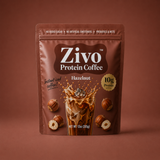
10g Protein. Real Coffee. Zero Added Sugar.
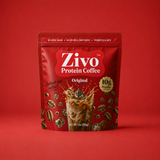
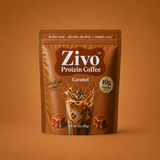
100% real coffee with premium whey protein already mixed in. Hit 10 grams of leucine-rich protein in the same amount of time it takes to make your morning cup. No meal required. Available in Original, Caramel, and Hazelnut.
- ✓ 10g whey protein per scoop
- ✓ 0g added sugar
- ✓ 100% real coffee
- ✓ MCTs for cognitive function
- ✓ Prebiotic fiber
- ✓ Ready in seconds, hot or iced
Start the anabolic window before your day has even begun.

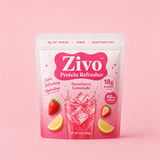
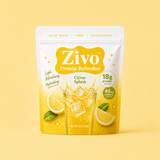
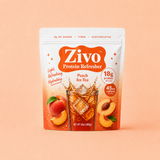
18g Protein and Prebiotics. Light Enough to Drink Any Time.
A clear, fruit-flavored drink that delivers 18 grams of clean protein, prebiotic fiber, and electrolytes throughout the day. For hitting the distributed protein targets the research recommends, without a second meal. Available in Strawberry Lemonade and Peach Ice Tea.
- ✓ 18g clean protein per serving
- ✓ 0g added sugar
- ✓ Prebiotic fiber
- ✓ Electrolytes for hydration
- ✓ Light, non-chalky texture
- ✓ No artificial additives
The mid-day protein dose that actually fits into a normal schedule.
Real People. Real Results.
I am 38 and had been stuck with the same 15 pounds for two years. My dietitian finally told me the real issue was protein. I was eating maybe 50 grams a day. The Protein Coffee gets me 20 grams before 8am without any effort. Three months in and my body composition has genuinely shifted. Less fat, more muscle, and I am not hungry all afternoon anymore.
I am 44 and my doctor flagged that I was losing muscle faster than expected for my age. He told me to prioritize protein, especially in the morning. The Protein Coffee is the only change I made in the first month. My follow-up numbers were noticeably better and I actually have energy again before noon.
Post-menopausal and trying to maintain muscle while losing weight. My nutritionist said 130 grams of protein a day minimum. That felt impossible. The Protein Coffee in the morning and the Refresher in the afternoon gets me more than halfway there before dinner. Nothing else has been this easy to stick to.
I work out four times a week and thought I was getting enough protein. Turns out I was hitting maybe 80 grams on a good day. Since adding both Zivo products I am consistently above 140 grams. My recovery is faster and I finally broke through a plateau I had been stuck at for six months.
I skip breakfast most days because I am just not hungry in the morning. My energy would crash by 11am and I never understood why. The Protein Coffee fixed that completely. I get protein and coffee in one, my energy is stable all morning, and I am not raiding the snack drawer before lunch anymore.
20 Grams of Protein. Prebiotics. Fiber. Zero Added Sugar. In Your Morning Coffee.
The research is clear on what protein does and when timing matters. The only thing left is a format that actually fits a real morning. This is that format.
TRY IT NOW - UP TO 66% OFF2. Wolfe RR. "The role of dietary protein in optimizing muscle mass, function and health outcomes in older individuals." Protein Summit 2.0, British Journal of Nutrition, 2012.
3. Stokes T et al. "Recent perspectives regarding the role of dietary protein for the promotion of muscle hypertrophy with resistance exercise training." Nutrients, 2018.
4. International Society of Sports Nutrition Position Stand: Protein and exercise. Journal of the International Society of Sports Nutrition, 2023.
5. Leidy HJ et al. "The role of protein in weight loss and maintenance." American Journal of Clinical Nutrition, 2015.
6. Areta JL et al. "Timing and distribution of protein ingestion during prolonged recovery from resistance exercise alters myofibrillar protein synthesis." Journal of Physiology, 2013.
7. Westerterp-Plantenga MS et al. "High protein intake sustains weight maintenance after body weight loss in humans." International Journal of Obesity, 2004.
8. Moore DR. "Maximizing post-exercise anabolism: the case for relative protein intakes." Frontiers in Nutrition, 2019.
9. Churchward-Venne TA et al. "Leucine supplementation of a low-protein mixed macronutrient beverage enhances myofibrillar protein synthesis in young men." American Journal of Clinical Nutrition, 2012.
10. Bauer J et al. "Evidence-based recommendations for optimal dietary protein intake in older people." Journal of the American Medical Directors Association, 2013.